Your Soil Isn’t Hungry. It’s Starving: Why Greenville Lawns Need Aeration and Carbon+
Quick Summary
Greenville homeowners with Bermudagrass, Zoysiagrass, and Centipedegrass lawns should consider aeration between late May and early July to relieve soil compaction and improve root development.
Canopy Lawn Care pairs aeration with Carbon+, a carbon-rich soil amendment that feeds beneficial soil microbes, improves nutrient cycling, and supports long-term soil health.
Key Takeaways
- Warm-season lawns naturally develop soil compaction over time.
- Core aeration improves oxygen, water, and nutrient movement into the root zone.
- Carbon+ feeds beneficial soil microbes and supports soil health.
- The best aeration window in Greenville is typically late May through early July.
- Healthier soil supports stronger, denser turf and improved drought resilience.
Most lawn care companies will never tell you this because saying it out loud makes much of the industry look outdated:
Your soil isn’t hungry. It’s starving.
Not for nitrogen (N). Not for phosphorus (P). Not for potassium (K).
Most Greenville lawns have received plenty of those nutrients over the years. Any company with a truck and a bag of fertilizer can spread NPK across a lawn.
The problem is that fertilizer alone isn’t what creates a healthy lawn.
The real issue lies beneath the surface.
The Living System Under Your Lawn
Plants do not simply “eat” fertilizer. They absorb nutrients through complex interactions between roots, microbes, and minerals.
Beneath every square foot of healthy turf is a microscopic ecosystem made up of billions of bacteria, fungi, protozoa, and other beneficial organisms. These microbes perform the work of unlocking nutrients and making them available to grass roots.
Two microbial groups play especially important roles:
- Bacillus
- Trichoderma
These beneficial organisms help release phosphorus, iron, zinc, magnesium, and other nutrients already present in the soil but unavailable to your grass.
Without microbial activity, many of these nutrients remain locked away.
The microbes are the engine.
The fertilizer is simply the fuel.
Why Warm-Season Lawns Need Aeration
If your lawn is Bermudagrass, Zoysiagrass, or Centipedegrass, your soil is likely becoming more compacted every year.
These warm-season grasses spread aggressively across the soil surface, creating a dense turf canopy that homeowners love. But beneath the surface, that same growth gradually compresses the soil, reducing the movement of air, water, and nutrients into the root zone.
Over time, compacted soil creates several problems:
- Reduced root growth
- Poor water absorption
- Increased drought stress
- Less efficient nutrient uptake
- Thinner, weaker turf
Even the best fertilizer program struggles when nutrients can’t effectively move through the soil profile.
That’s where core aeration comes in.
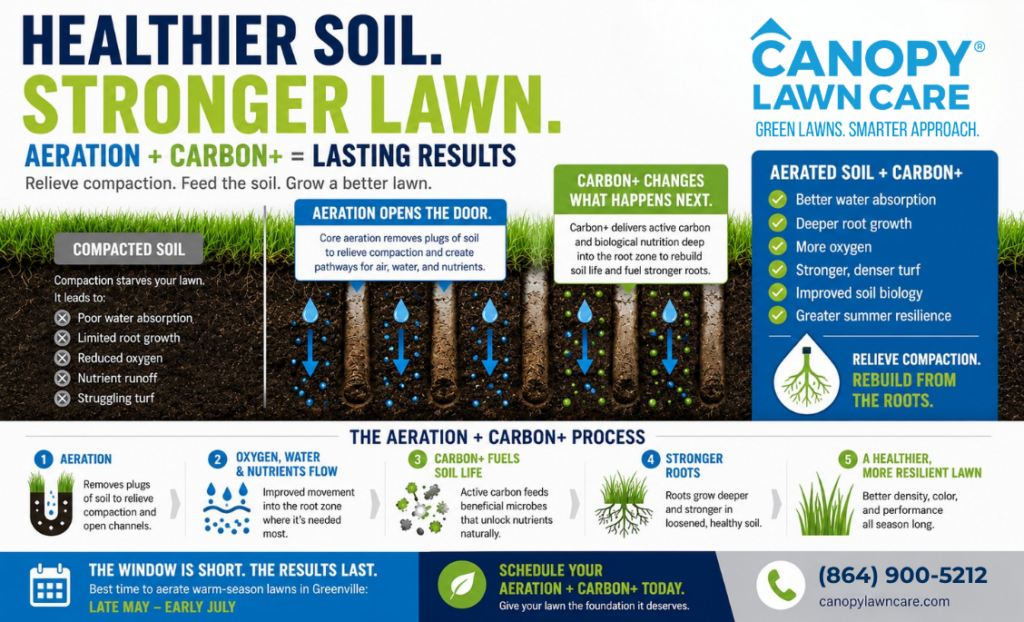
Core aeration removes thousands of small plugs from the lawn, creating pathways that allow oxygen, moisture, and nutrients to reach the roots. It helps relieve compaction and gives the soil room to breathe again.
But opening the door is only part of the solution.
What happens after aeration matters just as much.
The Hidden Problem with Conventional Lawn Fertilizers
Traditional lawn care programs often rely heavily on synthetic fertilizers.
These products create the quick green-up homeowners love because the grass can absorb nutrients directly.
But there is a tradeoff.
Many conventional fertilizers are salt-based. Over time, repeated applications can create soil conditions that reduce microbial populations.
As beneficial microbes decline, natural nutrient cycling slows down. The lawn becomes increasingly dependent on synthetic fertilizer to maintain the same appearance.
This creates a cycle:
- Fewer microbes
- Less natural nutrient availability
- Greater fertilizer dependence
- More microbial decline
It’s one reason many lawns that have received years of conventional treatments still struggle with density, resilience, and long-term health.
The lawn may look green.
The soil underneath may be exhausted.
What Greenville Soils Are Really Missing
The answer is carbon.
Not the kind discussed in climate headlines.
We’re talking about active, digestible carbon that beneficial soil microbes can use as a food source.
When carbon is introduced into biologically depleted soil, dormant microbial populations become active again. Nutrient cycling improves. Root systems strengthen. Soil health begins to recover.
The healthiest lawns often have one thing in common:
Aeration Opens the Door. Carbon+ Changes What Happens Next.
When most lawn care companies aerate a lawn, they stop there.
At Canopy Lawn Care, we pair aeration with Carbon+ because aeration creates the perfect opportunity to improve the living system beneath the turf.
The channels created by aeration allow active carbon, humic substances, and biological nutrition to move deeper into the soil profile where beneficial microbes live and work.
Instead of simply relieving compaction, we’re helping rebuild the microbial ecosystem responsible for nutrient cycling, root development, and long-term soil health.
Together, aeration and Carbon+ create results neither can achieve alone.
Aeration Alone vs. Aeration + Carbon+
| Aeration Alone | Aeration + Carbon+ |
|---|---|
| Relieves soil compaction | Relieves soil compaction |
| Improves oxygen flow | Improves oxygen flow |
| Supports root growth | Supports root growth |
| Improves water infiltration | Improves water infiltration |
| Improves soil structure | Improves soil structure |
| Limited biological impact | Feeds beneficial soil microbes |
| Short-term improvement | Improves nutrient cycling |
| Helps roots access resources | Supports healthier soil biology |
| Benefits typically fade over time | Builds long-term soil health |
| Improves lawn performance | Increases resilience to heat, drought, and stress |
Why Greenville Lawns Benefit From Carbon+
Carbon+ was developed around a simple principle:
Healthy lawns start with healthy soil.
Carbon+ combines:
- Active carbon from corn gluten, feather meal, bone meal, and molasses
- Humic acid derived from Leonardite
- Soluble silicon to improve stress tolerance
- Balanced macro and micronutrients for healthy growth
Unlike many traditional fertilizer products, Carbon+ focuses on feeding both the grass and the microbial community beneath it.
We also use biological slow-release technology rather than polymer-coated fertilizers, helping support microbial activity while avoiding plastic-coated fertilizer granules.
The result is a lawn program designed to improve the living system underneath your turf—not just the color above it.
Why Greenville Lawns Benefit From Aeration
Throughout Greenville and the Upstate, many lawns are built on clay-heavy soils that naturally compact over time.
Add summer heat, foot traffic, mowing equipment, and years of traditional fertilizer applications, and the result is often a lawn that looks acceptable on the surface but struggles beneath it.
Compacted soil limits:
- Root expansion
- Water infiltration
- Oxygen movement
- Microbial activity
That’s why many homeowners notice their lawn becoming increasingly dependent on fertilizer and irrigation to maintain appearance.
Healthy lawns don’t start with more fertilizer.
They start with healthier soil.
Why Timing Matters for Warm-Season Aeration
Unlike cool-season lawns, warm-season grasses can only be aerated successfully during active growth.
In Greenville, Bermudagrass, Zoysiagrass, and Centipedegrass are typically best aerated between late May and early July, when they can quickly recover and fill in after the aeration process.
Once summer stress intensifies, recovery becomes more difficult. Waiting until fall often means waiting until next year.
That makes this one of the most important lawn-improvement windows of the season.
If you’re considering aeration, the best time to schedule it is while your lawn is actively growing.
Key Facts About Lawn Aeration in Greenville, SC
- Best Aeration Timing: Late May through Early July
- Grass Types: Bermudagrass, Zoysiagrass, Centipedegrass
- Primary Benefit: Relieves soil compaction
- Secondary Benefit: Improves root growth
- Carbon+ Benefit: Supports soil biology and nutrient cycling
- Service Area: Greenville and Upstate South Carolina
- Recovery Period: Typically 2–6 weeks
- Long-Term Benefit: Healthier soil and stronger turf
Is Aeration and Carbon+ Right for Your Greenville Lawn?
This service is ideal for:
- Bermuda lawns
- Zoysia lawns
- Centipede lawns
- Clay-heavy soils
- Compacted lawns
- High-traffic yards
- Lawns with thinning turf
- Homeowners looking to improve soil health
- Lawns struggling during summer heat and drought
What Results Can Greenville Homeowners Expect?
Most homeowners notice improvements in stages after aeration and Carbon+ treatment.
- Better Water Absorption: Aeration helps rainfall and irrigation move into the soil instead of running across the surface of compacted ground.
- Stronger Root Development: Loosened soil allows roots to expand deeper and access more water and nutrients.
- Improved Turf Density: Over the following weeks, many homeowners notice thin areas beginning to fill in and overall turf density improving.
- Healthier Soil Biology: Carbon+ feeds beneficial microbes that help unlock nutrients already present in the soil and support long-term soil health.
- Greater Summer Resilience: Healthier roots and healthier soil help the lawn better withstand heat, drought stress, and environmental pressure throughout the growing season.
The goal isn’t simply a greener lawn.
The goal is healthier soil that supports stronger, thicker grass year after year.
Expert Insight From Canopy’s Director of Agronomy
“Healthy lawns aren’t built from the top down. They’re built from the soil up.” — Mike Hrivnak, Director of Agronomy, Canopy Lawn Care
Mike graduated from North Carolina State University’s Turfgrass Management Program and has spent more than two decades managing high-performance turf systems.
His experience includes maintaining playing surfaces for UNC Chapel Hill, the Durham Bulls, and the Washington Nationals before bringing that expertise to residential lawn care.
His philosophy is simple: build healthier soil first, and the lawn will follow.
Frequently Asked Questions About Lawn Aeration in Greenville
When should I aerate Bermuda grass in Greenville, SC?
The best time is during active growth, typically between late May and early July.
Is aeration worth it for Zoysia grass?
Yes. Aeration helps reduce soil compaction and improves oxygen, water, and nutrient movement into the root zone.
What is Carbon+?
Carbon+ is Canopy Lawn Care’s carbon-rich soil amendment designed to feed beneficial soil microbes and support long-term soil health.
How long does it take to see results from aeration?
Most homeowners notice improvements within 2–6 weeks, while soil health benefits continue throughout the growing season.
Does aeration help clay soil?
Yes. Aeration is one of the most effective ways to relieve compaction in clay-heavy Greenville soils.
Can I aerate in August?
Generally, no. Warm-season grasses recover best when aerated during active growth before extreme summer stress arrives.
Does aeration help drought tolerance?
Yes. Improved root development and healthier soil help lawns better withstand drought conditions.
How often should warm-season lawns be aerated?
Most warm-season lawns benefit from aeration every one to two years depending on traffic, soil conditions, and overall lawn health.
Reserve Your Warm-Season Aeration Before the Window Closes
For Greenville homeowners with Bermudagrass, Zoysiagrass, or Centipedegrass, there is only a short period each year when aeration can deliver maximum benefit.
Pairing aeration with Carbon+ helps take advantage of that window by relieving compaction while feeding the soil biology that supports long-term lawn health.
If you’ve been considering aeration this year, now is the time to schedule.
The window typically closes by early July as summer heat intensifies and recovery slows.
Get a Fast Quote
Contact Canopy Lawn Care Greenville today for a no-obligation quote on warm-season aeration and Carbon+.
We’ll evaluate your lawn, explain the process, and help determine whether your property is a good candidate for treatment this season.
Related Grass Guide, Lawn Care, Seasonal Tips
What Happens to Your Soil When Lawn Treatments Stop? A Real-World Case Study