What Happens to Your Soil When Lawn Treatments Stop? A Real-World Case Study
Most homeowners judge their lawn by what they can see: color, thickness, weeds and bare spots.
But some of the most important changes in a lawn happen underground.
In 2026, drought conditions forced Canopy Lawn Care to significantly reduce the normal treatment cadence on a Canopy-managed property that had been monitored over multiple years. That gave us an opportunity to ask an important question:
What happens to the soil when regular lawn treatments are interrupted?
The answer showed up in the soil.
A Real-World Look Beneath the Lawn
Canopy had been monitoring this property using the Haney Soil Health Test, which evaluates several indicators related to soil biology and nutrient cycling.
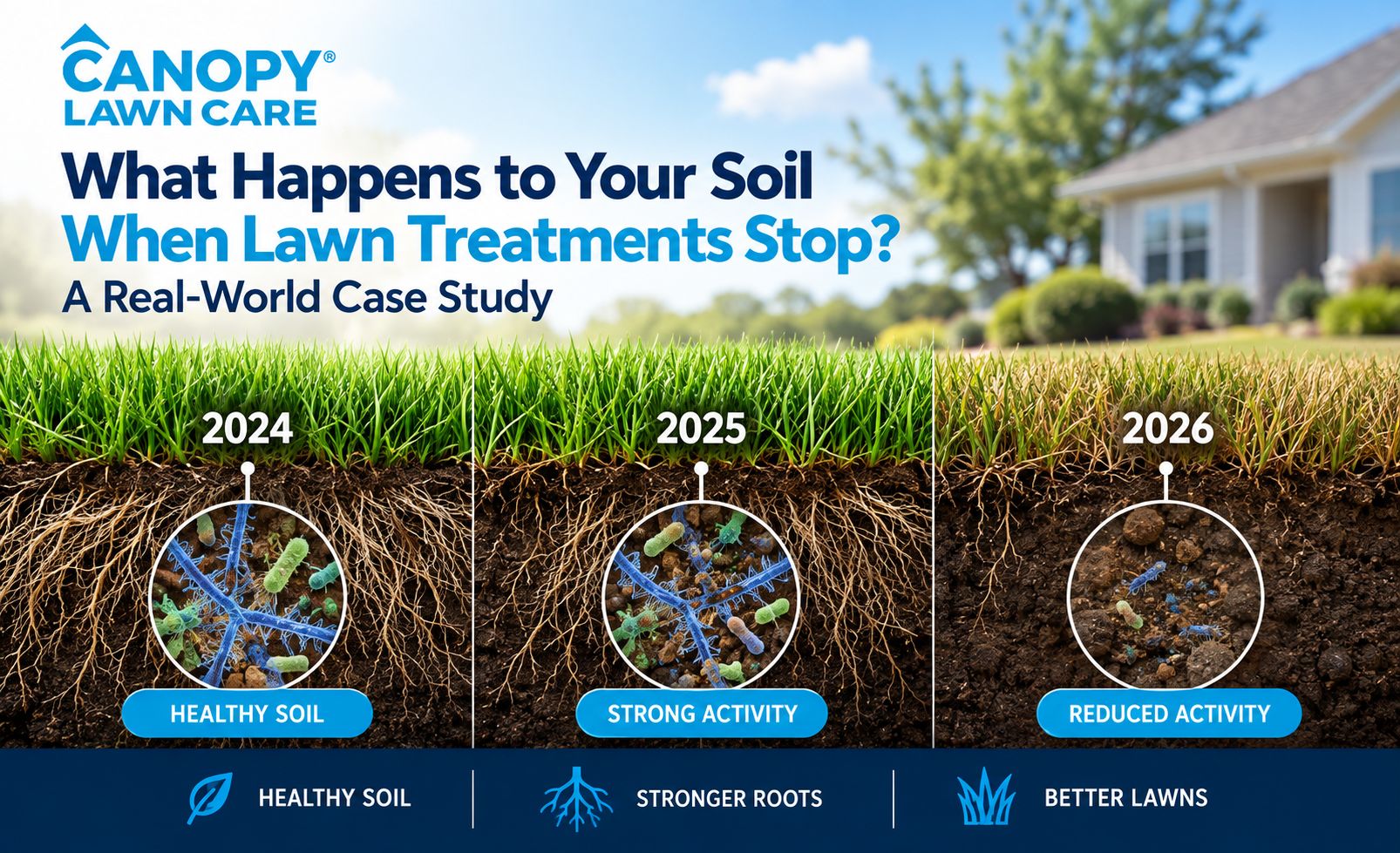
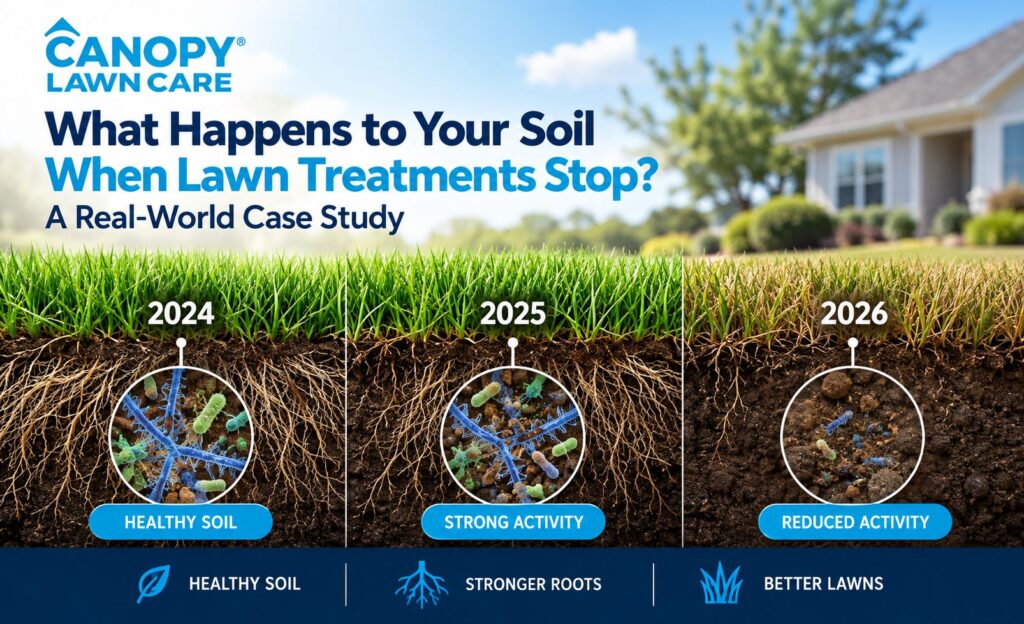
The property received Canopy’s full lawn-care program in 2024 and 2025. In 2026, drought conditions led to significantly fewer applications. The latest soil test then showed substantial changes compared with the previous year:
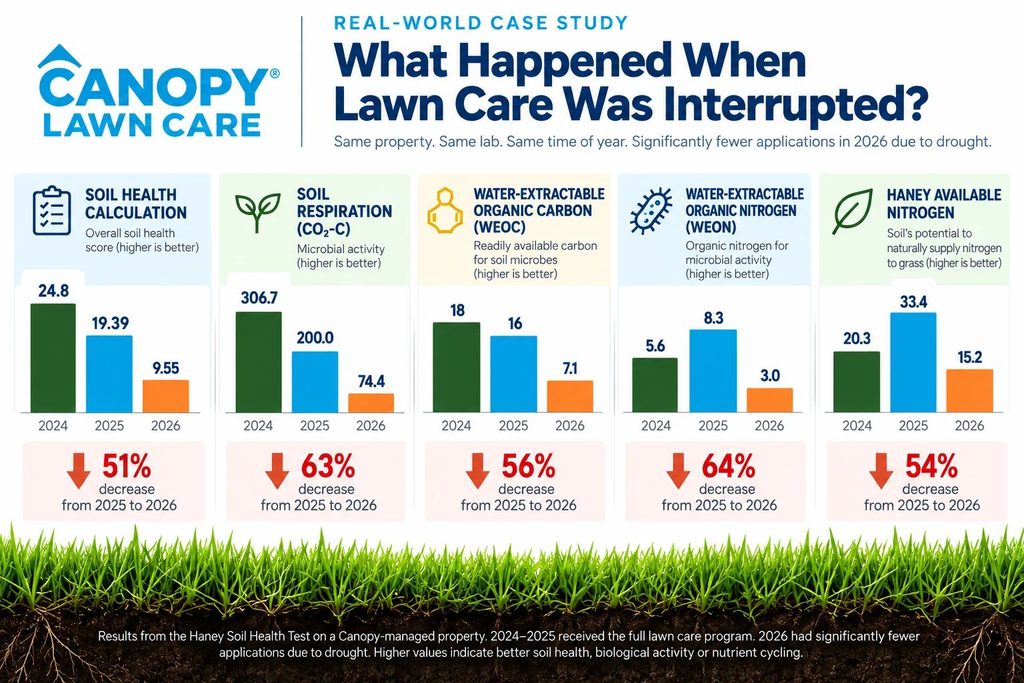
In other words, after the treatment cadence was reduced, the test indicated less readily available carbon and organic nitrogen, lower microbial activity and reduced potential for the soil to naturally supply nitrogen.
This is one property—not a controlled scientific experiment—so the results don’t prove that reduced treatments alone caused every change. Drought itself is an important factor.
But that’s exactly what makes the results interesting.
Drought Doesn’t Just Affect the Grass You See
Soil microbes help decompose organic material and cycle nutrients into forms plants can use. NC State Extension notes that soil microorganisms play important roles in nitrogen and phosphorus cycling and that they depend on a continuing supply of organic matter.
Moisture matters, too.
USDA’s Natural Resources Conservation Service explains that soil respiration reflects biological activity and is sensitive to soil moisture; very dry, hot soils generally have much lower microbial activity and respiration.
A 2024 peer-reviewed meta-analysis provides even broader evidence. Across studies, drought reduced soil microbial biomass by 31.6% and microbial respiration by 43.5%.
So when drought occurs, the challenge isn’t limited to brown grass. The biological system supporting the lawn can be affected as well.
Why Carbon, Nitrogen and Microbial Activity Matter
Think of healthy soil as a living system rather than simply dirt holding grass roots.
Microorganisms use carbon as an energy source while helping break down organic material and cycle nutrients. University of Minnesota Extension identifies nutrient cycling, nutrient retention, water infiltration and soil structure among the important functions supported by soil organisms.
That’s also why Canopy measures indicators such as soil respiration, water-extractable organic carbon and organic nitrogen. These are among the biological and chemical indicators used in the Haney Soil Health Test.
No single measurement tells the entire story of a lawn. In fact, researchers caution that Haney test results should be interpreted within local soil, climate and management conditions rather than treated as a universal score.
But tracking the same property over time can help reveal how the soil system is changing.
Lawn Care Isn’t Just About Feeding Grass
This is where Canopy’s Soil First approach differs from simply applying fertilizer to make grass greener.
The goal of the HealthyLawn Program is to continually support the soil-plant system with carefully selected nutritionals and treatments that encourage healthier soil, stronger roots and more efficient nutrient cycling.
When environmental conditions require treatments to be adjusted, the lawn doesn’t suddenly lose everything that has been built. On this property, organic matter, pH and carbon-to-nitrogen ratio remained at solid levels even after the interrupted season.
The foundation was still there.
But the biological activity measured by the test had slowed considerably.
The Homeowner Takeaway
A lawn is an ecosystem, and maintaining that ecosystem requires consistency.
Drought, heat and other stresses may change what your lawn needs at a particular moment. That doesn’t mean every application should continue unchanged regardless of conditions. Good lawn care should respond to the lawn, weather, soil and season.
But stopping lawn care altogether can also mean stopping some of the inputs and management practices designed to support the system below the grass.
That’s why Canopy doesn’t just ask, “How green is the lawn?”
We want to know: How well is the soil functioning?
Because healthier lawns start below the surface.
Healthy Soil. Stronger Roots. Better Lawns.
Related Grass Guide, Lawn Care, Seasonal Tips

How Much Should You Water Your Lawn? A Guide for Warm- and Cool-Season Grass