Not All Grass Seed Is the Same: Why Seed Quality Matters When Overseeding Your Lawn
Summary
Why Seed Quality Matters:
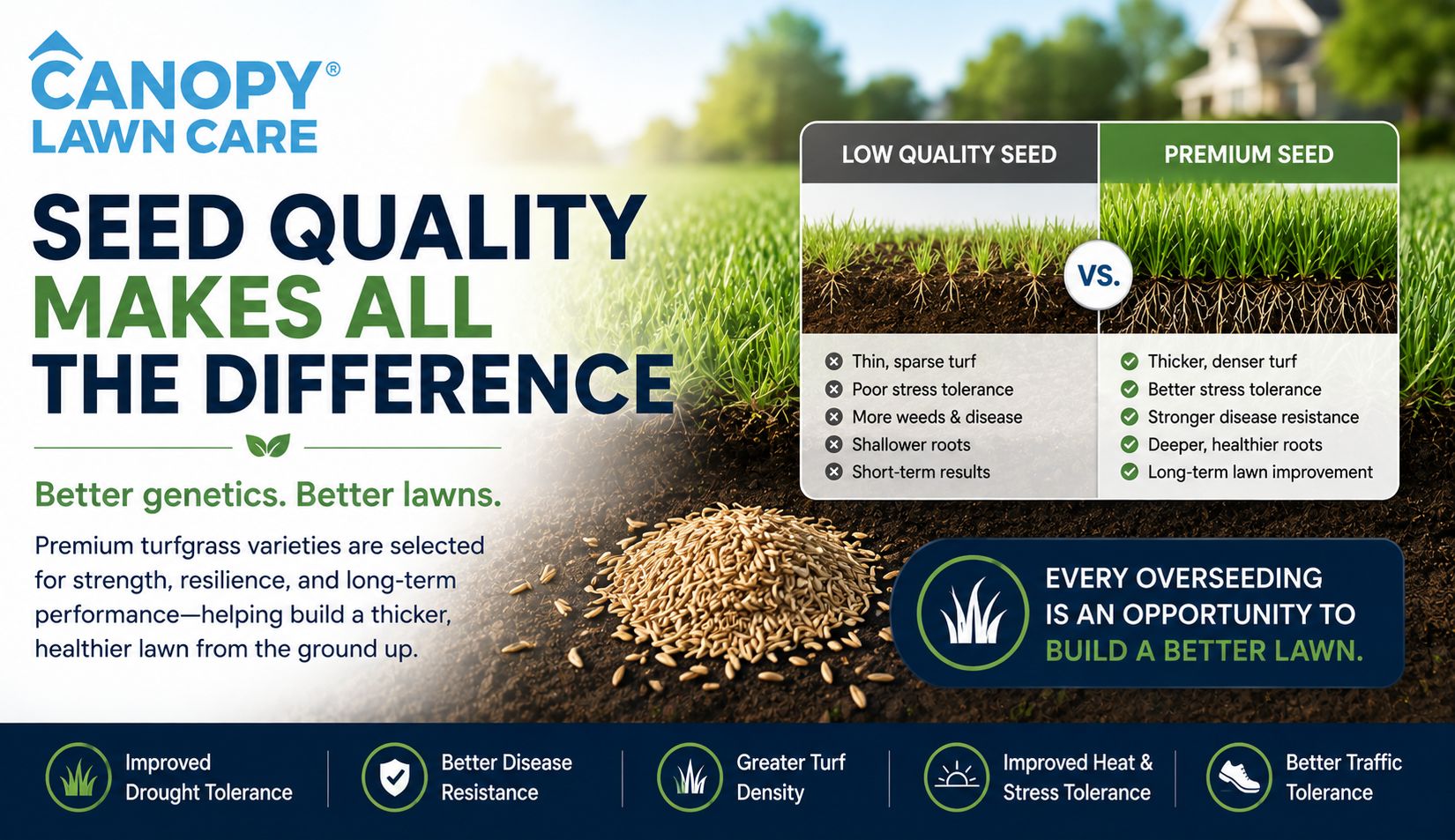
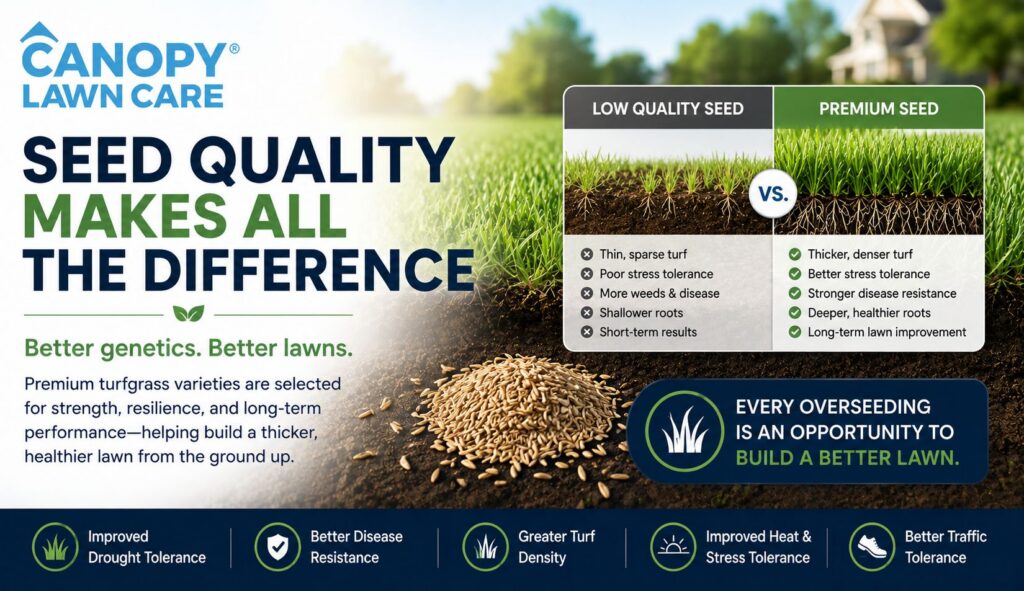
- Better genetics: Premium varieties are selected for stronger long-term performance.
- Greater resilience: Improved tolerance to drought, heat, disease, and seasonal stress.
- Thicker turf: Better density helps create a fuller lawn and compete against weeds.
- Long-term improvement: Each overseeding is an opportunity to introduce better-performing grass into your lawn.
When homeowners think about overseeding, the goal often seems simple: put down grass seed to help fill thin or bare areas.
But the quality of the grass seed you introduce can have an impact on your lawn long after the new grass germinates.
At Canopy Lawn Care, we view overseeding as more than replacing grass that has been lost. It’s an opportunity to introduce carefully selected turfgrass varieties with improved genetics designed to create a thicker, healthier and more resilient lawn.
In other words, you’re not just adding more grass.
You’re improving the lawn you’re growing.
Grass Seed Has Genetics, Too
Walk through the lawn and garden section of a home improvement store and you’ll find plenty of grass seed options.
They may look similar in the bag, but that doesn’t mean they’ll perform the same once they’re in your lawn.
Just like varieties of tomatoes, apples or other plants have different characteristics, individual turfgrass cultivars have their own genetic traits.
Some may tolerate drought better. Others may demonstrate better resistance to certain diseases. Some establish more effectively or produce denser, more uniform turf.
Modern turfgrass breeding allows seed producers to select for characteristics such as:
- Improved drought tolerance
- Better disease resistance
- Faster establishment
- Greater turf density
- Improved heat tolerance
- Better traffic tolerance
- More consistent color
- Better overall survivability
That’s why selecting grass seed based primarily on price can miss one of the biggest opportunities overseeding provides.
The seed you introduce today can influence how your lawn performs for years to come.
Better Genetics Can Build a More Resilient Lawn
Fertilization and proper lawn care are important, but there’s a limit to what lawn treatments alone can accomplish.
The genetic potential of the grass itself matters.
Imagine two grass plants growing beside each other in the same soil, receiving the same amount of water, sunlight and nutrition. One variety may naturally handle summer heat or disease pressure better than the other simply because of its genetics.
That’s where premium seed selection becomes important.
Canopy sources professional turfgrass varieties selected for long-term performance rather than treating grass seed as a commodity.
Our seed partners evaluate turfgrass cultivars through research sites across the United States, studying how different varieties perform under varying environmental conditions.
The objective is straightforward: Find varieties that demonstrate the characteristics necessary to build healthier, better-performing lawns.
Overseeding Doesn’t Just Repair Your Lawn. It Can Improve It.
This changes the way we think about overseeding.
Consider a cool-season lawn that has been growing for several years.
Every summer brings heat, drought, disease pressure, foot traffic and other environmental stresses. Some grass plants survive while others decline, leaving behind thinner areas in the turf.
Overseeding gives us an opportunity to replace some of what’s been lost—but it can do something more important at the same time.
We can introduce newer, improved turfgrass genetics into the existing lawn.
Over time, repeated overseeding can help continually strengthen the overall turf population.
That can contribute to:
- Thicker, denser turf
- Greater lawn uniformity
- Better tolerance of environmental stress
- Improved drought performance
- Greater disease resistance
- Better competition against weeds
- Stronger long-term lawn performance
Instead of simply restoring yesterday’s lawn, you’re helping build a better lawn for tomorrow.
Seed Quality Can Also Support a More Preventative Approach to Lawn Care
A healthier lawn can often defend itself better.
Dense turf leaves less open space for weeds to establish. Grass varieties with greater disease resistance may be better equipped to withstand certain disease pressures. Improved drought and heat tolerance can help turf remain healthier when environmental conditions become difficult.
That doesn’t mean better seed eliminates weeds, disease or the need for professional lawn care.
It means we’re building a lawn that’s better prepared to handle those challenges.
That’s an important distinction in Canopy’s approach.
Rather than relying only on treatments after problems appear, our goal is to continually improve the underlying health and resilience of the lawn.
Better genetics are another tool that helps us do that.
Premium Seed Still Needs the Right Environment
Even exceptional grass seed can’t overcome poor growing conditions.
For seed to successfully germinate and establish, it needs access to moisture, oxygen, nutrients and healthy soil.
That’s one reason aeration and overseeding work so well together.
Core aeration relieves soil compaction while creating openings that allow seed to reach the soil surface. That improved seed-to-soil contact helps create a better environment for germination and early root development.
But the process doesn’t stop there.
At Canopy, our soil-first approach focuses on creating an environment where those improved turfgrass genetics can reach their potential.
Healthy soil provides the foundation. Premium seed provides the genetics.
Together, they help create healthier roots and stronger turf.
What Does Premium Grass Seed Mean for a Homeowner?
You don’t need to become a turfgrass expert or memorize cultivar names to make a better decision about overseeding.
Instead, ask a better question.
Don’t just ask:
“How much seed are you putting down?”
Ask:
“What kind of grass are we introducing into my lawn?”
With Canopy’s overseeding program, the objective isn’t simply to put down grass seed. It’s to introduce carefully selected turfgrass genetics that can contribute to better lawn performance over time.
That means you’re investing in characteristics such as greater density, better stress tolerance, improved disease resistance and stronger long-term performance.
Better Genetics. Better Lawns.
At Canopy Lawn Care, we believe great lawns are built over time.
Every season gives us another opportunity to improve the soil, strengthen the root system and introduce better-performing grass varieties.
That’s why we don’t view overseeding as simply a seasonal add-on.
We view it as an investment in the future of your lawn.
Better soil creates the foundation.
Better genetics help maximize its potential.
And together, they help build a thicker, healthier and more resilient lawn that’s better prepared for whatever the next season brings.
Frequently Asked Questions
Does grass seed quality really matter?
Yes. Different turfgrass varieties have different genetic characteristics. Higher-performing varieties may offer advantages such as improved drought tolerance, disease resistance, turf density, heat tolerance and overall survivability.
What makes Canopy’s grass seed different?
Canopy sources premium turfgrass varieties selected for performance rather than simply purchasing commodity seed based on cost. Seed varieties are evaluated for characteristics such as turf quality, establishment, disease resistance, drought performance and durability.
Does premium grass seed germinate better?
Seed quality is an important part of successful establishment, but germination also depends heavily on soil conditions, temperature, seed-to-soil contact and consistent moisture. Even high-quality seed needs the right environment to perform.
Why combine aeration with overseeding?
Core aeration relieves soil compaction and creates openings in the lawn that improve seed-to-soil contact. Pairing aeration with overseeding gives new grass seed a better environment to germinate and establish.
Related Grass Guide, Lawn Care, Seasonal Tips
What Happens to Your Soil When Lawn Treatments Stop? A Real-World Case Study